HERCULES
An Open-Source Simulation Framework for Heterogeneous Multi-Robot SLAM, Collaborative Perception, and Exploration
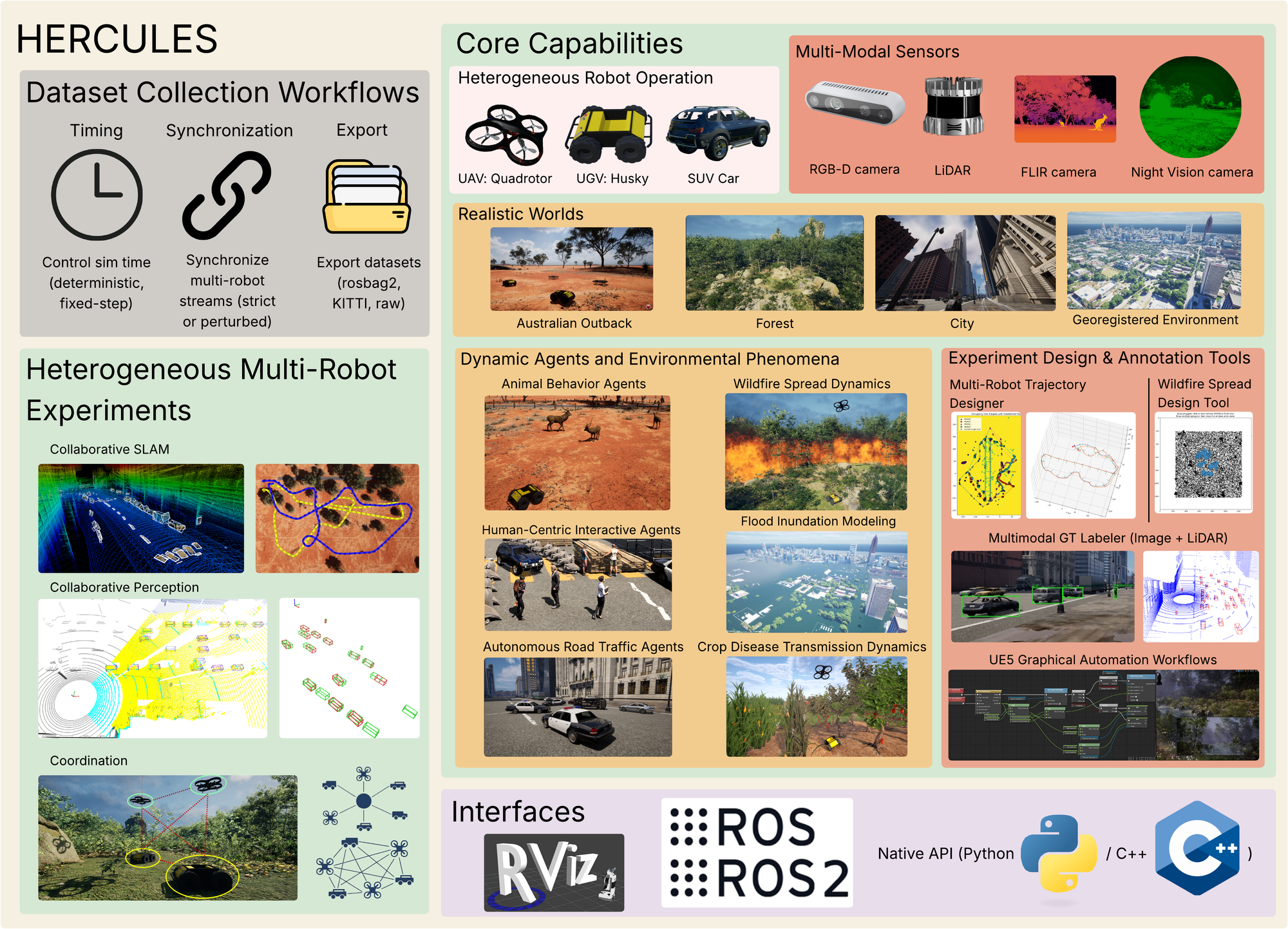
HERCULES is a simulation platform for heterogeneous multi-robot autonomy that lets unmanned ground vehicles (UGVs) and unmanned aerial vehicles (UAVs) collaboratively explore and understand large-scale, complex environments. It is an advanced fork of AirSim / Cosys-AirSim built on Unreal Engine 5.
Getting Started Code arXiv Dataset
What HERCULES adds
HERCULES extends Cosys-AirSim with a unified heterogeneous autonomy stack, new sensor modalities, dynamic environments, and ready-to-run multi-robot benchmarks:
- Heterogeneous UAV–UGV autonomy — concurrent UAV and UGV operation in a single simulation session, a unified waypoint-level command interface, an autonomous UGV controller, and coordinated multi-robot sensor logging.
- LWIR thermal camera — a physics-based long-wave infrared sensor using Planck-law spectral radiance.
- Night-vision camera — a configurable low-light sensor with empirical photometric transfer.
- Dynamic environmental phenomena — wildfire spread, flood inundation, and crop-disease transmission, plus dynamic agents (pedestrians, traffic, wildlife).
- Collaborative SLAM (ROMAN) — a ready-to-run multi-robot SLAM benchmark.
- Cooperative perception (DAIR-V2X) — V2X-style multi-view 3D detection baselines.
- Multimodal dataset — synchronized RGB, depth, semantic, and LiDAR export in KITTI-style layouts and ROS 2 bags.
It inherits the full Cosys-AirSim / AirSim sensor suite and API surface — cameras, depth, semantic segmentation, LiDAR, GPU-LiDAR, echo/radar, IMU, GPS, instance segmentation, annotation, skid-steer vehicles, and more — documented under Simulator.
Environments
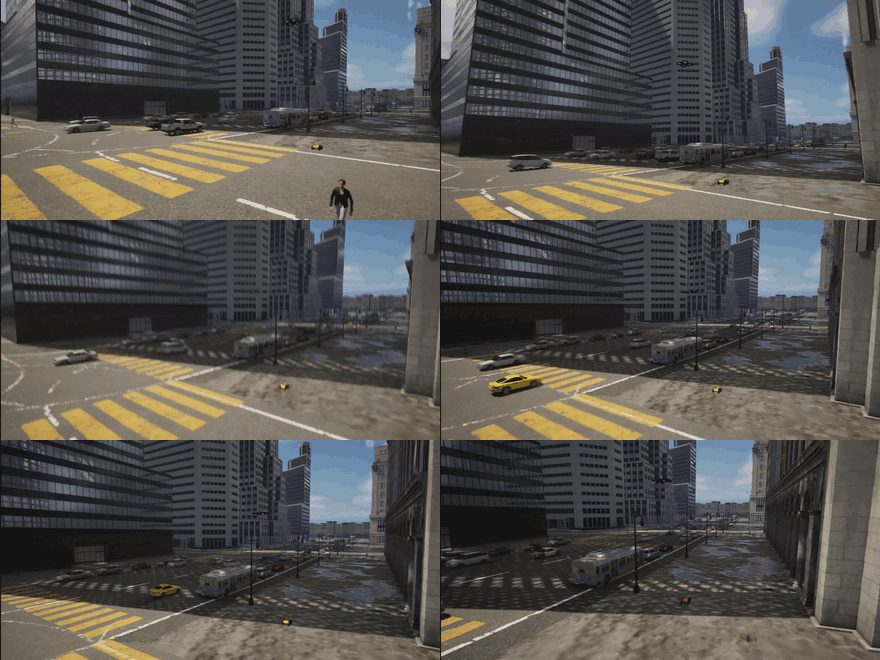
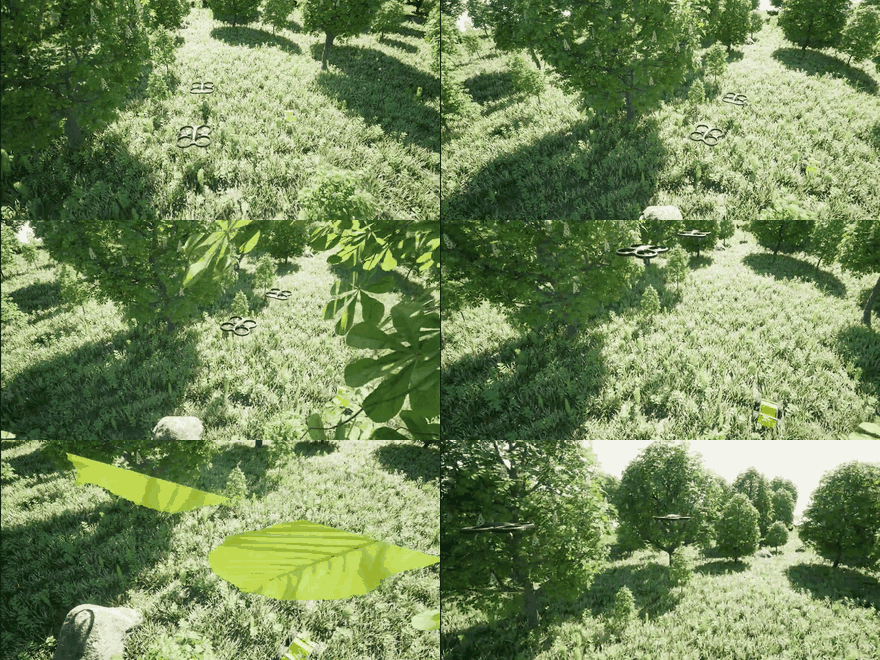
Three photorealistic worlds — desert, forest, and city — each stress a different class of perception and planning failure, plus georeferenced real-world scenes via Cesium for Unreal.
Quick links
- Install: Linux · Windows · Precompiled plugin · Docker
- Configure: Settings
- Develop: Python APIs · ROS 2 wrapper
Citation
@misc{garimella2026hercules,
  title         = {HERCULES: An Open-Source Simulation Framework for Heterogeneous Multi-Robot SLAM, Collaborative Perception, and Exploration},
  author        = {Garimella, Sandilya Sai and Butterfield, Daniel Chase and Wilson, Sean and Gan, Lu},
  year          = {2026},
  eprint        = {2606.22756},
  archivePrefix = {arXiv},
  primaryClass  = {cs.RO},
  url           = {https://arxiv.org/abs/2606.22756}
}
Acknowledgements
HERCULES builds on AirSim (Microsoft) and Cosys-AirSim (Cosys-Lab, University of Antwerp), and benchmarks ROMAN (MIT-ACL) and DAIR-V2X. Developed at LunarLab, Georgia Institute of Technology. Released under the MIT License.